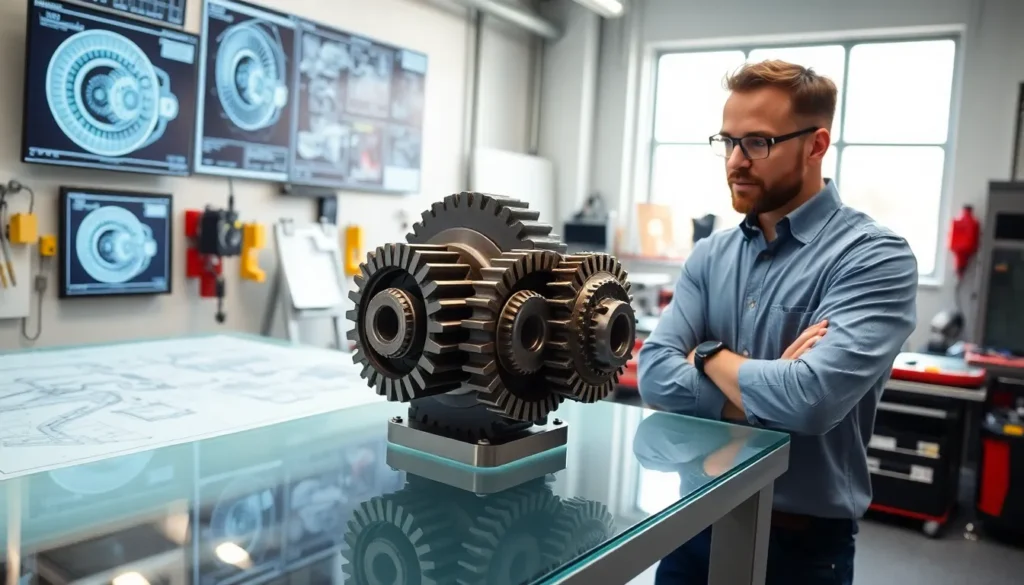
Ever tried pushing a car at a standstill? It’s like wrestling with a bear – you need a little help from mechanics to get anywhere. Enter the gear system, the unsung hero of machinery and vehicles alike. These ingenious contraptions might not wear capes, but they certainly have the power to transform motion and force. Whether it’s your bicycle, a wind turbine, or that mighty robot vacuum buzzing around your house, gear systems are quietly working behind the scenes. So buckle up as we dive deep into the world of gears – they’re more fascinating than they sound.
What Is a Gear System?

A gear system consists of interconnected gears that transfer motion and force. Think of gears as the teeth of a machine, engaging in various configurations to achieve the desired speed, torque, and direction of movement. At its core, the primary function of any gear system is to enhance efficiency, whether it’s in simple tools or complex machinery.
Each gear features teeth that mesh with another gear, creating a mechanical advantage. When one gear turns, it forces the other gears to move, eventually allowing for the transfer of power.
Gears come in various shapes and sizes, designed to meet diverse mechanical needs. Their clever arrangement can transform speed: for instance, a small gear turning more quickly can effectively drive a larger gear at a slower rate. This ratio creates the balance of power across different machines, from the everyday bicycle to industrial machines.
Types of Gear Systems
There are several types of gear systems, each tailored for specific applications. Here’s a look at some of the most common:
- Spur Gears: These are the most straightforward type, with teeth that are straight and parallel to the gears’ axis. They’re commonly used in gear drives due to their simplicity and ease of manufacturing.
- Helical Gears: Unlike spur gears, helical gears have angled teeth, allowing for smoother and quieter operation. They can handle greater loads and are typically found in car transmissions and other high-performance machinery.
- Bevel Gears: These gears allow for the transfer of power between non-parallel shafts, commonly found in diverse applications ranging from hand drills to vehicle drive trains.
- Worm Gears: Worm gears consist of a worm (screw) and gear with teeth that mesh. They provide a high torque reduction and allow for a 90-degree shaft rotation, commonly used in tuners and lifting devices.
- Planetary Gears: This system consists of a sun gear, planet gears, and a ring gear, providing high torque in a compact space. Often used in automatic transmissions and electric motors, they achieve effective load distribution.
Each gear type serves a unique function, making the choice of gear type critical in system design.
Components of a Gear System
Every gear system is made up of several essential components that work together seamlessly:
- Gears: The key players in any gear system, they come in varying sizes and shapes as discussed before.
- Shafts: These are rods that mount the gears, providing support and allowing for rotation.
- Bearings: Bearings reduce friction between moving parts, ensuring smooth gear rotation. Without them, the system could overheat or become inefficient.
- Casing: This provides protection to the internal components and can influence noise levels and efficiency, especially in automotive or industrial applications.
- Lubricants: Keeping everything moving smoothly requires quality lubricants to minimize wear and tear on the gears.
How Gear Systems Work
Understanding how gear systems function involves delving into the interaction between different gears. When a gear rotates, its teeth engage with the teeth of another gear, which causes that gear to turn. This interaction is known as gear reduction.
Gear ratios determine how fast one gear turns relative to another. When a smaller gear drives a larger one, the larger gear rotates more slowly compared to the smaller one, but it generates more torque. This principle is what allows machines to perform difficult tasks, such as lifting heavy loads or accelerating from a standstill.
Imagine riding a bicycle uphill: shifting to a smaller gear gives you the chance to pedal easier while the rear wheel still turns at a productive speed. Gear systems make tasks easier by allowing for these adjustments in power and speed, showcasing their efficient mechanical design.
Applications of Gear Systems
The versatility of gear systems makes them applicable in countless fields:
- Automotive Industry: Transmissions use complex gear systems to manage power transfer from the engine to the wheels. This allows for smoother rides and better fuel efficiency.
- Industrial Machines: Gear systems enable conveyor belts and robotic arms to function, assisting in manufacturing processes.
- Bicycles: Gears adjust the level of effort required to pedal, making biking efficient, especially on varied terrains.
- Aerospace: Gear systems in planes control engines and navigation, ensuring safe and reliable flight.
- Robotics: They provide precise control over movements in robotic systems, enhancing capabilities and functionalities.
Advantages of Using Gear Systems
Using gear systems brings numerous advantages that improve mechanical performance:
- Efficiency: Gears enable smoother power transfer, reducing energy waste.
- Compact Design: Systems can be designed with smaller sizes without sacrificing power or efficiency.
- Versatility: Gears can be fine-tuned for specific applications, ensuring optimal performance.
- Durability: High-quality materials and proper lubrication increase longevity, reducing replacement costs.
- Load Distribution: Gears can disperse loads evenly, enhancing system reliability.
Future Trends in Gear Systems
The future of gear systems looks bright, with innovations focusing on performance enhancement and sustainability. Engineers are looking into smart materials that adapt to stress and environmental conditions, creating stronger yet lighter gears.
Also, advancements in automation and robotics are pushing for more complex gear designs that can handle greater loads while requiring less maintenance. The quest for energy efficiency is driving research into hybrid gear systems that combine traditional metallic gears with polymer materials to reduce weight and improve energy transfer.